
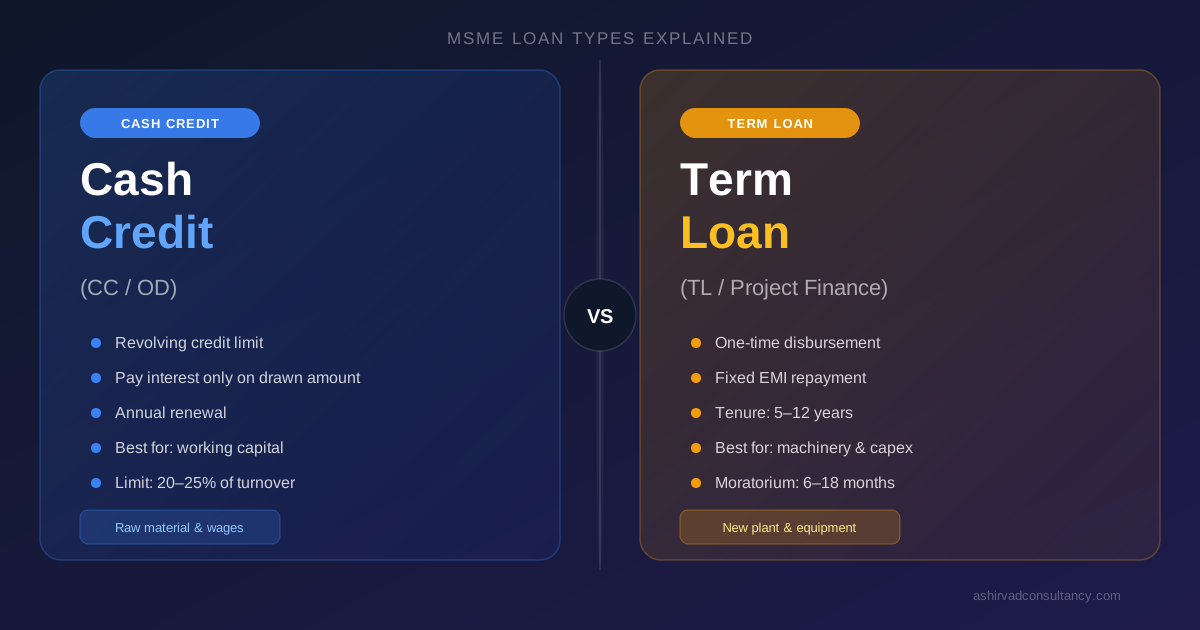
Most business owners know they need a "bank loan." But banks offer two fundamentally different products — and using the wrong one costs you money. Cash credit and term loans serve different purposes. Understanding the difference helps you structure the right facility and save on interest.
The Core Difference in One Line
- Term loan: Borrow a fixed amount, repay in EMIs. Used for capital expenditure.
- Cash credit (CC): A revolving limit you draw and repay as needed. Used for working capital.
What Is a Term Loan?
A term loan is a one-time disbursement of a fixed amount that you repay through equal monthly instalments (EMIs) over a fixed period — typically 3 to 7 years for MSME purposes.
How it works:
- Bank sanctions ₹50 Lakh for 5 years at 9%
- Money is disbursed (often in tranches for construction projects)
- You pay a fixed EMI of ~₹1.04 Lakh per month for 60 months
- Outstanding balance reduces with each payment
Interest calculation: On the outstanding (reducing) balance. As you repay, you pay less interest each month.
Used for:
- Buying machinery or equipment
- Building a factory or expanding premises
- Setting up a new manufacturing unit
- Buying commercial property
You cannot re-draw money you've repaid on a term loan. Once repaid, that portion is closed.
What Is a Cash Credit (CC)?
A cash credit is a revolving credit facility — the bank sets a limit, and you can draw and repay repeatedly within that limit, as many times as you need.
How it works:
- Bank sanctions a CC limit of ₹20 Lakh
- You draw ₹12 Lakh to pay suppliers
- When customers pay you, you deposit ₹8 Lakh back
- Your outstanding is now ₹4 Lakh — and you're paying interest only on ₹4 Lakh
- Next month you need ₹15 Lakh again — you draw it
Interest calculation: Only on the amount drawn, only for the days it's outstanding. If you use ₹10 Lakh for 15 days in a month, you pay 15 days of interest on ₹10 Lakh — not a full month.
Used for:
- Buying raw materials
- Paying wages and operational expenses
- Funding debtors (customers who haven't paid yet)
- Managing inventory
You can re-draw any repaid amount within the sanctioned limit.
Key Differences at a Glance
| Feature | Term Loan | Cash Credit |
|---|---|---|
| Purpose | Capital expenditure | Working capital |
| Disbursement | One-time (or tranched) | Draw as needed |
| Repayment | Fixed EMI | Flexible; repay when you have cash |
| Interest | On reducing balance | Only on amount drawn |
| Tenure | 3–10 years | 1 year (renewed annually) |
| Re-draw | No | Yes, within limit |
| Collateral | Asset being purchased + property | Stocks + debtors + sometimes property |
What About an Overdraft (OD)?
An overdraft works like a CC — revolving, flexible — but is typically sanctioned against:
- Fixed deposits (FD-backed OD)
- Property (OD against property, also called ODAP)
- Insurance policies
The mechanics are the same as CC. The difference is the underlying security and the bank product code. For MSMEs, CC and OD are often used interchangeably.
How Banks Decide Your CC Limit
Banks calculate working capital limits based on your operating cycle — the time between spending money (raw material, wages) and receiving money (customer payment).
A simplified formula:
CC limit = 75% of (Current Assets − Current Liabilities)
Where:
- Current Assets = Stock + Debtors (under 90 days) + Advance to suppliers
- Current Liabilities = Creditors + Advance from customers
So if you have ₹50 Lakh in stock + ₹30 Lakh in debtors − ₹20 Lakh in creditors:
CC limit = 75% of (₹80L − ₹20L) = 75% of ₹60L = ₹45 Lakh
Presenting accurate, updated stock and debtor statements is key to maximising your CC limit.
Getting Both Together: The Right Structure
Most manufacturing businesses need both:
- Term loan to buy machinery and set up / expand
- Cash credit to fund day-to-day operations
Banks sanction these as a combined project — called a Mixed Credit Facility. When you apply for a term loan for machinery, a good consultant also gets the working capital assessed at the same time. This is far more efficient than going back to the bank a year later when your CC runs low.
Example structure for a ₹1 Crore machinery project:
- Term loan: ₹75 Lakh (7 years)
- Cash credit: ₹25 Lakh (assessed based on projected turnover)
- Promoter contribution: ₹25 Lakh (25% margin)
Common Mistakes
Using a term loan for working capital: If you take a 5-year term loan to fund operations (instead of a CC), you're paying interest on money you may not need next month. A CC only charges you for what you use.
Under-sizing the CC limit: Many businesses take a small CC and then struggle — drawing it fully within days of each renewal. Getting the CC correctly sized upfront avoids this.
Not renewing the CC on time: CC limits must be renewed annually. Failure to renew — even if you're performing perfectly — can cause the bank to call the limit. Set calendar reminders 60 days before expiry.
How We Help
Ashirvad Consultancy structures term loans and CC/OD facilities for Gujarat manufacturers. We assess the right split, prepare the project report, and present your file to banks who are actively lending in your sector and city.